
Ecommerce Reporting
EPR Reporting for Ecommerce: A Practical Guide
An EPR report may end as a few totals entered into a portal. Getting to those totals is the real work.
Every ecommerce order can contain product packaging, a box or mailer, tape, labels and filling material. Sell the same products in several countries, and those amounts may need to be grouped differently under national packaging reporting requirements.
Extended Producer Responsibility, or EPR, makes producers financially or organisationally responsible for products and packaging when they become waste. This article focuses on the practical reporting work. For the wider definition, see our complete guide to what EPR means.
Across Europe, the exact registration, reporting and fee process depends on the country and product stream.
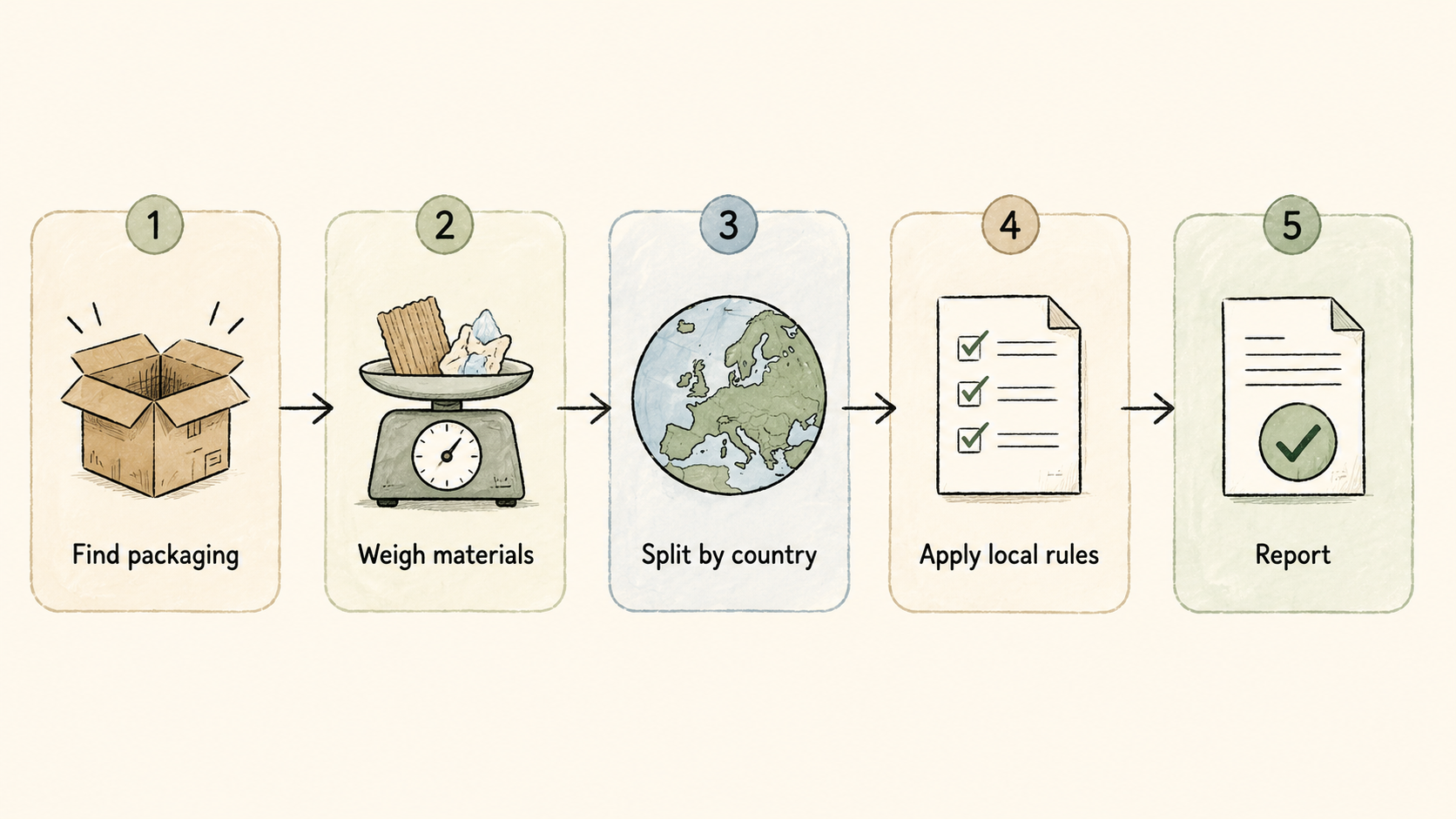
A practical five-step path from packaging data to reporting-ready EPR outputs.
You do not start with the report. You start with the data behind it
A reporting portal does not know that one of your products uses 42 grams of cardboard and 6 grams of plastic. It only knows the totals you enter.
Before filing, you normally need to determine where you have obligations, register with the relevant authority or scheme, collect the underlying data, apply the local categories and document how the figures were calculated. The submission itself is often the easy part.
The process is also not identical across Europe. Our Germany guide explains why sellers must report matching packaging volumes to the system operator and the official LUCID Packaging Register .
If Denmark is one of your markets, our Danish EPR guide shows how the 8-tonne threshold and total packaging reporting work in practice.
What do you actually need for EPR reporting?
Most ecommerce businesses need five basic building blocks.
1. A clean SKU list
Start with a consistent list of the products you actually sell.
If the same product has different names in your ecommerce platform, your warehouse system and a spreadsheet, it becomes easier to count it twice or miss it completely.
Bundles also need attention. One order line may contain several separately packaged products.
2. Reliable packaging materials and weights
Each product needs a packaging profile showing its components, materials and weights.
A simple profile could contain:
- 35 g of cardboard
- 4 g of plastic film
- 2 g of paper label
Do not record only the largest component. Labels, sleeves, caps and inserts may belong to different categories.
Use measured or documented weights wherever possible. Supplier specifications can help, but if that is not available a basic scale is often better than a guess copied into every future report.
3. Packaging added during fulfilment
The packaging around the product is only part of an ecommerce order.
You may also need to account for shipping boxes, mailers, tape, labels and filling material.
Fulfilment packaging is often included in EPR obligations, and ignoring it can understate your volumes. Remember to include all relevant packaging, not just the one directly surrounding the product.
4. Sales data split by country
A single European sales total is not enough.
Your data needs a clear destination-country split and the correct reporting period. Useful order fields normally include:
- Destination country
- Order date
- SKU
- Quantity
- Order status
- Fulfilment method
5. The correct reporting logic for each market
Countries and EPR schemes can use different categories, deadlines, units and submission formats.
You therefore need to know not only what the packaging contains, but how the data must be translated for the market.
Packaging may not be your only EPR stream. Electrical products, batteries, certain single-use plastic items, as well as categories like tires, vehicles, fishing gear and textiles can create separate obligations with their own reporting logic and requirements.
How to turn orders and SKUs into reporting-ready EPR data
Once the underlying data is organised, the calculation is straightforward.
Imagine that you sell 500 units of one SKU in Germany. Each unit contains:
- 40 g of paper and cardboard
- 8 g of plastic
The product packaging contributes:
- 20 kg of paper and cardboard
- 4 kg of plastic
You then add the packaging used to ship those orders. If different box sizes were used, apply the correct packaging instead of adding one average box to everything.
A practical workflow is:
- Map each SKU to its packaging components.
- Define how to include packaging used when fulfilling orders, such as boxes, tape and filling material.
- Split the result by country and reporting period.
- Apply country-specific rules, reporting formats and modulated fee structures, then convert the totals into the required local categories.
- Review unusual changes before submitting.
This is the point where normal ecommerce data becomes EPR data.
Why EPR reporting gets messy faster than expected
The formula is simple: units multiplied by weight.
Real ecommerce data is rarely simple.
A product may change packaging halfway through the year. Two warehouses may pack the same SKU differently. A bundle can contain products that are also sold separately. Returns may be handled differently across systems. A supplier may replace plastic with cardboard without telling the compliance team.
The same product can also create several obligations. An electronic product with a battery may require packaging, WEEE and battery reporting.
Good EPR tracking therefore records the calculation rules, not just the final totals.
Common mistakes that create extra work
Guessing packaging weights
A small difference becomes significant across thousands of orders.
Counting orders instead of units
One order can contain several packaged products.
Forgetting fulfilment packaging
Product packaging and warehouse packaging often live in different systems.
Mixing markets or reporting periods
Save the exact country, dates and order-status filters used for each report.
Keeping the logic in one person's spreadsheet
A file becomes risky when nobody else understands its formulas and manual corrections.
Waiting until deadline week
Packaging data is easiest to collect when a product is added or changed.
When is a spreadsheet enough?
A spreadsheet can work well when you have a small, stable product range, simple packaging, few markets and one clear owner of the process.
It becomes harder when you have many SKUs, several fulfilment setups, frequent changes or recurring country-specific reports.
That is usually when teams start copying the same order export into multiple files and rebuilding similar calculations every month or quarter.
Good EPR software should do more than provide another place to type totals.
EPR reporting software is most useful when it:
- Stores packaging data at SKU level
- Applies repeatable logistics rules
- Connects orders to the correct packaging
- Identifies missing data
- Preserves the calculation method
- Creates country-specific exports
Automation does not remove the need to understand your obligations. It removes much of the repetitive work between an order being placed and a report being ready.
Can better EPR data reduce your fees?
Potentially, but it depends on the country and scheme.
Many packaging fees are linked to material type and weight. Some schemes also use modulated fees, where characteristics such as recyclability affect the rate.
Accurate component-level data can therefore show which packaging creates the largest cost and whether a change may have a financial benefit.
Do not assume an automatic saving. A recyclable package does not receive the same treatment everywhere, and fee tables can change.
Businesses will increasingly need data that describes not only packaging weight, but also material composition and design.
A simple reporting routine
EPR reporting is easier when it becomes a routine rather than a deadline project.
Every month
Add new SKUs, record packaging changes and resolve missing data.
Before a deadline
Confirm the market, period, categories and format. Reconcile the calculation with your order data and investigate unusual changes.
After submission
Save the report, supporting dataset, calculation rules and confirmation documents.
What does PPWR change?
The Packaging and Packaging Waste Regulation entered into force on 11 February 2025 and generally starts applying on 12 August 2026.
It introduces more harmonised requirements relating to packaging design, recyclability, recycled content, reuse and waste prevention.
PPWR makes structured packaging data more important, but it does not make operational EPR work disappear.
Businesses still need to know which packaging they place in each market and maintain reliable documentation.
For a quick internal overview, see our PPWR FAQ section , or read Regulation (EU) 2025/40 on EUR-Lex.
EPR reporting checklist
Before your next submission, check that you have:
- A consistent SKU list
- Packaging materials and weights for each product
- Setup for shipping packaging
- Order quantities split by destination country
- The correct period and order-status logic
- Separate data for other applicable EPR streams
- The right categories and format
- A saved calculation method and supporting dataset
If several items are missing, start with the SKU and packaging mapping. Once that foundation is reliable, the reports become much easier to produce.
See how EPR reporting can be automated
EPR Insights connects ecommerce order data with product and packaging rules, helps track EPR data across markets and creates country-specific reporting exports. Contact us to book a demo and see how the workflow can fit your business.
Contact us